Empowering nursing students to practice clinical judgment

Designed for multiple nursing education settings

Psychiatric Mental Health Nursing

  • De-escalation
  • Therapeutic communication
  • Crisis response
  • Emotional regulation

Fundamentals of Nursing

  • Patient education
  • Communication basics
  • Safety checks
  • Professional boundaries

Medical-Surgical Nursing

  • Discharge planning
  • Post-op teaching
  • Medication education
  • Symptom escalation

Simulation Lab & Clinical Prep

  • Pre-brief practice
  • Role-play replacement
  • Remediation
  • Repeatable skills practice

Use TMind AI across nursing courses,
simulation labs, and clinical preparation

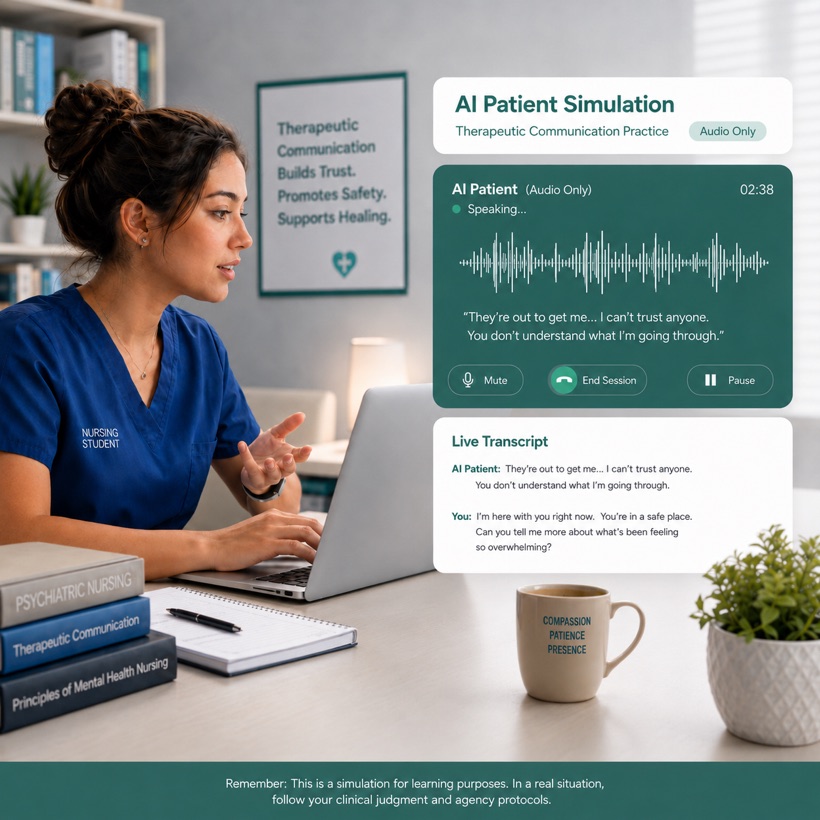
Psych-nursing de-escalation simulation

Psych-Nursing &
Behavioral De‑escalation

Practice responding to anxious, agitated, manic, paranoid, or distressed patients using therapeutic communication and verbal de-escalation.
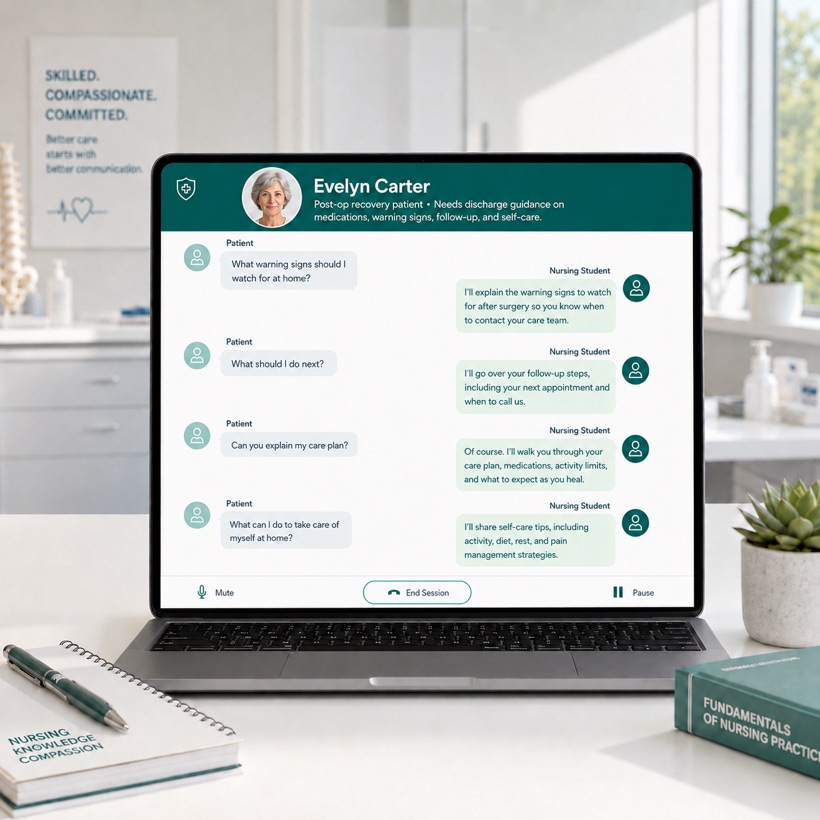
Patient education and discharge planning simulation

Patient Education & Discharge Planning

Students practice explaining care plans, post-op instructions, warning signs, follow-up steps, and self-care routines.
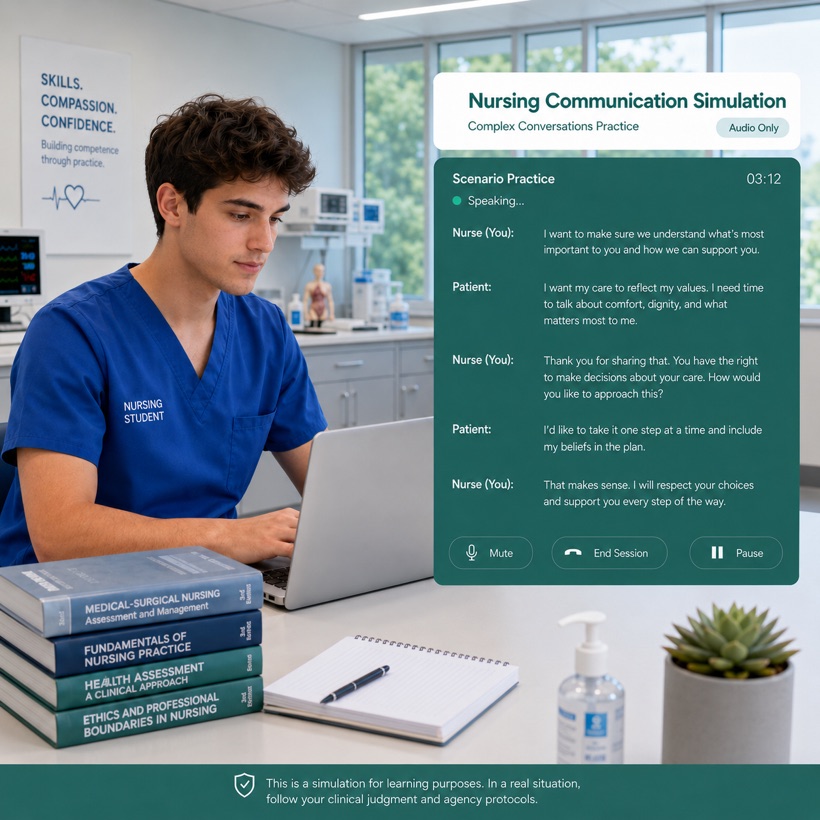
Ethical dilemmas and cultural humility simulation

Ethical Dilemmas &
Cultural Humility

Students practice navigating family conflict, patient autonomy, cultural beliefs, end-of-life conversations, and professional boundaries.

The Simulation Gap

Physical labs are essential for mechanics, but communication and judgment require a different kind of precision.

Focus Area
Traditional Manikin
Standardized Patients
TMind AI Virtual Patients
Capabilities
Physical Tasks
Communication
Judgment & Soft Skills
Cost
High
High
Low
Accessibility
Laboratory Bound
Scheduled Only
24/7/Scalable
Feedback
Manual Instructor Review
Subjective Actor Notes
AI-Driven Real-time Data

Nursing students need more safe, realistic practice

High-Stakes, Low-Risk

A safe environment for Psych-Nursing training, psychiatric de-escalation, and navigating complex ethical dilemmas without real-world risk.

Scalable Data

Automatically track and grade entire cohorts. Shift from anecdotal evidence to quantitative performance metrics for every student.

NCLEX-Ready

CJMM alignment focused on the critical "Recognize Cues" and "Analyze Cues" phases, preparing students for the Next Gen NCLEX with precision.

Assess the skills that matter in nursing practice

Evaluation Report

Student: Alex Chen · Scenario: Medication Management

30/35 Overall Score
Therapeutic Communication3
Patient Safety5
Medication Education5
Teach-Back5
Empathy4
Professionalism4
Escalation Judgment4

Patient Safety

The student demonstrated strict adherence to clinical safety protocols. This metric measures the execution of the 'Five Rights' of Medication Administration, specifically the verification of Two-Patient Identifiers (Name/DOB) and a confirmed Allergy Check.

Notes

1st Session

Client was unsure how to manage the prescribed medication and asked about side effects, warning signs, and follow-up steps.

Reviewed dosage timing, medication purpose, allergy precautions, and when to contact the care team.

TMind AI helps faculty evaluate not only what students say, but how they communicate, educate, prioritize, and respond under pressure.

  • Score cards per simulation
  • Comment directly on the session transcripts
  • Take notes during practice
  • Class-level analytics dashboard

Give every student more practice without increasing faculty workload

Benefits for Faculty

  • Create repeatable simulation assignments
  • Customize scenarios by course objective
  • Review transcripts and rubric-based feedback
  • Identify students who need support
  • Scale practice beyond limited lab time

Benefits for Students

  • Practice before real clinical encounters
  • Build confidence in difficult conversations
  • Receive immediate structured feedback
  • Repeat scenarios safely
  • Learn from mistakes without patient risk

Frequently Asked Questions

AI simulation for nursing education uses virtual patients and clinical scenarios to help nursing students practice communication, patient education, clinical reasoning, and safety-focused conversations before working with real patients. TMind AI allows faculty to create realistic nursing scenarios such as medication teaching, SBAR handoff, discharge planning, psychiatric nursing, and behavioral de-escalation.
Nursing schools can use TMind AI to create practice assignments, simulation lab prep, remediation, skills labs, and clinical preparation activities. Students can practice with AI-simulated patients or clinical agents, receive structured feedback, and build confidence in high-stakes conversations such as medication education, handoff communication, and patient discharge teaching.
Yes. TMind AI can support medication management training by helping nursing students practice how to explain medication schedules, side effects, adherence barriers, safety precautions, and follow-up instructions to virtual patients. The focus is on patient education, communication clarity, teach-back, and escalation judgment, not replacing clinical decision-making or medication-ordering systems.
TMind AI can simulate patients who are confused, overwhelmed, skeptical, distracted, or have low health literacy. Nursing students can practice explaining medication instructions in plain language, checking for understanding, using teach-back, identifying patient concerns, and knowing when to escalate questions to a provider, pharmacist, or supervising clinician.
Yes. TMind AI is especially useful for psychiatric mental health nursing scenarios because students can safely practice responding to anxious, agitated, manic, paranoid, or distressed virtual patients. These simulations help students develop therapeutic communication, de-escalation, emotional regulation, safety assessment, and professional boundary-setting skills.
TMind AI can provide structured feedback based on clarity, clinical safety, escalation behavior, therapeutic communication, empathy, professionalism, patient safety, teach-back, and cultural sensitivity. Instructors can review scorecards, transcript comments, notes, and improvement areas.
No. TMind AI is designed to complement in-person nursing simulation labs, not replace them. It gives students more opportunities to practice before, between, or after lab sessions. Faculty can use it for pre-brief preparation, repeated practice, remediation, communication skill-building, and scenarios that are difficult to simulate in person.

Bring AI-simulated nursing practice into your program

Explore how TMind AI can support nursing communication, medication teaching, SBAR handoff, psychiatric nursing, discharge planning, and clinical preparation.